
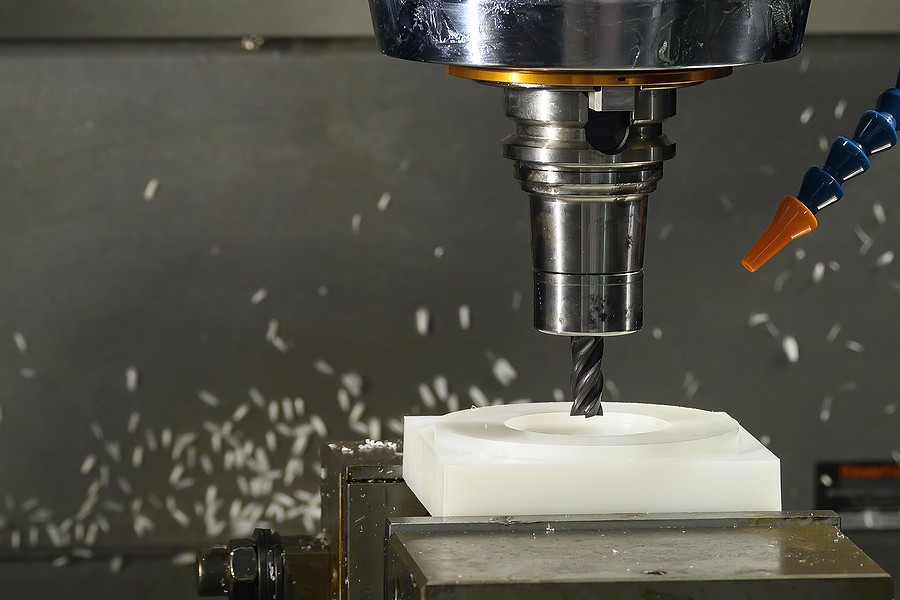
CNC machining technology is widely integrated across thousands of manufacturing businesses. According to the International Trade Administration, more than 65% of all U.S. manufacturing companies use CNC technology. CNC machines are compatible with a wide variety of materials, including nylon.
Materials Used in CNC Machining
CNC machining can be used to cut and shape a wide variety of materials, including metals–aluminum, stainless steel, brass, and copper, plastics, like nylon, wood, composites like fiberglass and carbon fiber, and various types of foams.
Benefits of CNC Machining
There are many benefits of CNC machining, including unparalleled precision and extremely tight tolerances, high production efficiency, production of products with complex geometries and intricate designs, production cost-effectiveness in producing parts in both small and large quantities, consistency and reproducibility, design flexibility, and scalability.
Nylon CNC Machining
Nylon is a versatile and widely used material in CNC machining due to its exceptional properties, including high tensile strength, low coefficient of friction, and resistance to wear and abrasion. These properties make nylon an excellent choice for applications requiring durability and reliability, such as gears, bushings, and bearings. Nylon’s low moisture absorption and good dimensional stability ensure consistent performance even in humid or varying temperature conditions.
Applications of Plastics in CNC Machining
Plastic materials are an excellent choice for many machining projects. Here are some common types of plastics used in CNC machining: acrylic (PMMA), polycarbonate (PC), nylon, ABS, Delrin, and PTFE. Because plastic parts are lightweight yet durable, cost-effective for production, and flexible in design, their use is crucial in modern manufacturing. Plastic CNC machined parts are used in many industries, including automotive, aerospace and defense, medical and healthcare, electronics and telecommunications, and consumer goods.
Tips for Nylon CNC Machining
- Use the right grade of nylon that is most suitable for the part being machined.
- Use the right cutting speed, appropriate to the type of nylon being machined.
- Ensure that the material is clean and dry before machining.
- Use sharp, high-quality cutting tools, such as single-flute end mills, to achieve clean cuts.
- Keep feed rates between 0.002 to 0.008 inches per tooth for effective results.
- Take light, shallow depths of cut, for example, 0.020 to 0.050 inches, to reduce friction and heat buildup.
- Use non-aromatic, air-based coolants to keep the manufactured part cool, prolong tool life, and improve finish on the part.
- Use O-flute bits and ensure good chip evacuation to prevent melting and stringy chips.
- Ensure appropriate clamps are used to hold the nylon part securely.
- Provide good support for the workpiece to prevent it from deforming under the pressure of the cutting tool.
Choose a Highly Regarded CNC Machining Company for Precision Parts
Contact Components By Design, based in Charlotte, N.C. Components By Design, Inc. has over 15 years of experience with CNC routers and CAD / CAM software, and exists to help your complex projects become simple. We offer a complete range of CNC routing services. From simple parts to complicated 3D machining, we can take on any project to add value to your product. We are experienced in machining parts from panel material and solid wood, PVC extruded sheets, acrylics, aluminum, and solid surfaces. Our CNC solutions are well-suited for cabinet makers, architectural woodworkers, building suppliers, sign makers, plastic fabricators, and more.