
Article Summary
- CNC machining uses computer-controlled tools for high-precision manufacturing.
- CNC lathes rotate the workpiece to shape cylindrical parts like shafts and cones.
- CNC mills move the cutting tool across a stationary workpiece to create complex shapes.
- Lathes offer smoother surface finishes for symmetrical parts.
- Mills handle intricate features like holes, slots, and 3D geometries.
- Each machine suits different applications based on part shape and design complexity.
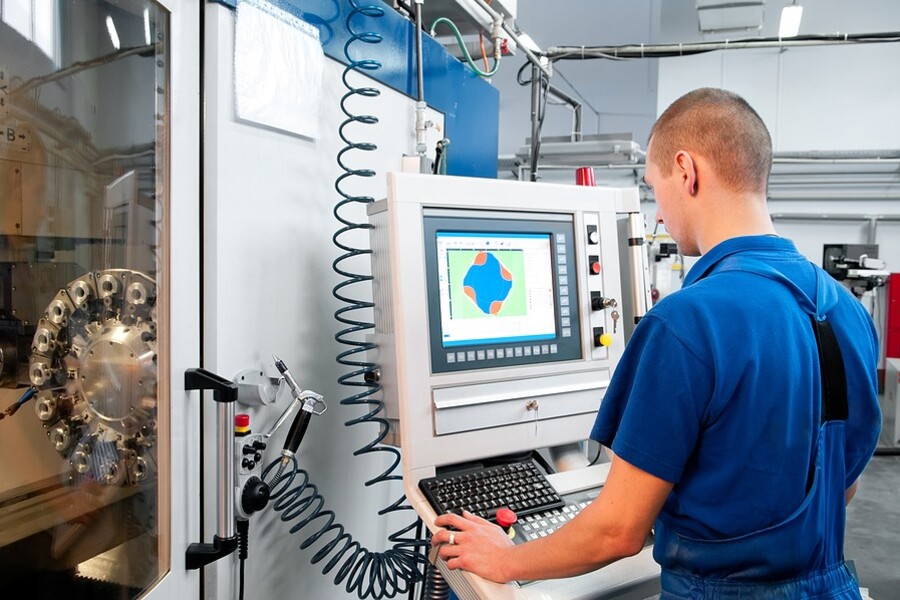
CNC machining (Computer Controlled Machining) describes versatile manufacturing processes that use a computer to control machine tools and remove material from a raw workpiece to create high-precision parts from a variety of materials. As someone said, “The thrill of creation begins at the intersection of design and machine.” One of the key CNC machines is the CNC lathe.
The Advantages of CNC Machining
Compared to traditional machining methods, CNC machining offers attractive manufacturing benefits.
- CNC machining generates minimal to no waste.
- It is more accurate and has no defects.
- It offers more rapid and effective production.
- It makes products whose components are faster and simpler to assemble.
- Automation eliminates many hazards associated with manual machining.
- It uses less electrical energy than older processes.
- It can reduce production costs.
Various CNC Machines
Six of the most common CNC machines, each specialized for specific tasks, are:
- CNC mill: used for cutting and shaping materials.
- CNC lathe: designed for turning cylindrical parts.
- CNC plasma cutter: uses a high-velocity jet of ionized gas to cut through materials and is commonly used for metal fabrication.
- CNC laser cutter: uses a focused laser beam to cut and engrave a wide range of materials, including metal, plastic, and wood.
- CNC router: ideal for cutting, carving, and engraving wood, plastic, and other softer materials, and often used in woodworking and signage industries.
- CNC electric discharge machine: uses electrical discharges via electrodes to shape conductive materials.
CNC machines can be used on a wide range of materials.
CNC Lathe vs. CNC Mill: What’s the Difference?
The differences in functionality between a CNC lathe and a CNC mill make each machine ideal for different parts.
A CNC lathe creates cylindrical parts using a tool that spins a workpiece against a stationary cutting tool. The CNC lathe is best used for parts that have rotational symmetry, like shafts, cones, and cylinders. The surface finish from this CNC lathe process often results in a smoother finish due to the consistent contact of the tool as it rotates against the part.
A CNC mill produces parts as it spins and moves against a stationary workpiece. The CNC mill is best used for complex, intricate, and non-rotational shapes, including slots, holes, and 3D geometries. The setup for a CNC mill can be more complex, especially for irregular or large parts that require precise fitting to prevent damage. The surface finish from this process may require additional finishing steps to achieve a perfectly smooth surface on complex parts.
CNC lathes and mills usually use metal bar stock to shape a part or an item.
Choose a Highly Regarded CNC Machining Company
Contact Components By Design, based in Charlotte, NC. Components By Design, Inc. has over 15 years of experience with CNC routers and CAD / CAM software and exists to help your complex projects become simple. We offer a complete range of CNC routing services. From simple parts to complicated 3D machining, we can take on any project to add value to your product. We are experienced in machining parts from panel material and solid wood, PVC extruded sheets, acrylics, aluminum, and solid surfaces. Our CNC solutions are well-suited for cabinet makers, architectural woodworkers, building suppliers, sign makers, plastic fabricators, and more. If you can think it, we can make it.