
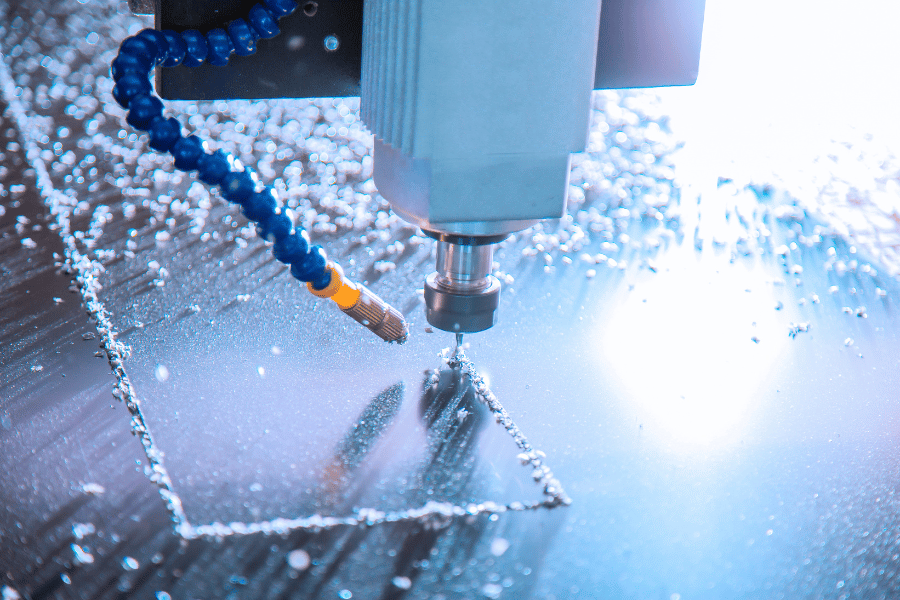
Article Summary
- A computer numerical control (CNC) router uses computer-programmed instructions to precisely cut, carve, drill, mill, and shape materials.
- CNC machining helps manufacturers improve accuracy, repeatability, production efficiency, quality control, and scalability.
- Common CNC machines include mills, lathes, routers, plasma cutters, laser cutters, water jets, and electric discharge machines.
- CNC routers can work with materials including wood, plastics, aluminum, brass, foam, and other manufacturing materials.
- CNC routing is used for applications such as cabinetry, millwork, signage, prototypes, furniture, and custom manufactured components.
What is a Computer Numerical Control (CNC) Router?
Computer Numerical Control (CNC) machine technology has revolutionized modern manufacturing and design. CNC machines play a pivotal role in modern manufacturing, driving innovation by enhancing precision and efficiency. One CNC machine used extensively is the computer numerical control router.
The Benefits of CNC Machining for Manufacturing
CNC machining offers manufacturers several advantages that can improve precision, efficiency, consistency, and scalability:
- High Precision: CNC machines can achieve accuracy within thousandths of an inch, making them well suited for parts with tight tolerances and detailed specifications.
- Consistent Repeatability: Once programmed, CNC machines can produce identical parts repeatedly, helping reduce errors and maintain consistent product quality.
- Increased Production Efficiency: CNC machines can operate for extended periods with minimal human intervention, supporting high-volume production and greater productivity.
- Manufacturing Flexibility: CNC machines can be programmed to manufacture a wide range of components, making them useful for prototypes, short production runs, and larger manufacturing projects.
- Improved Workplace Safety: Automation reduces the amount of direct interaction operators have with cutting tools and other moving machinery during production.
- Reduced Labor Requirements: Automated machining can reduce the amount of hands-on labor required for repetitive manufacturing processes.
- Faster Production: CNC machining can produce parts faster than many manual methods, helping manufacturers reduce lead times and improve overall production efficiency.
- Lower Scrap Rates: Precise, repeatable machining can reduce errors and wasted material, helping manufacturers control production costs.
- Improved Quality Control: Consistent programming and machining processes make it easier to maintain specifications and quality standards across production runs.
- Greater Scalability: CNC machining allows manufacturers to increase production while maintaining consistency as demand grows.
These benefits apply across many types of CNC equipment, including the computer numerical control router, making CNC machining a versatile solution for a wide range of manufacturing applications.
The Types of CNC Machines
The following are common types of CNC machines:
- Mill. It rotates a cutting tool to remove material from a stationary workpiece. Milling tools can move horizontally or vertically across three to six axes.
- Lathe. It cuts and shapes workpieces while they rotate around a central axis. It can also perform sanding, drilling, turning, and facing functions.
- Router. A computer numerical control router carves designs into the surface of flat, soft materials on a worktable. The tool can also cut, mill, and drill.
- Plasma cutter. It uses a torch to cut heavy materials on a worktable.
- Laser cutter. It is like a plasma cutter but uses a laser instead.
- Water jet. It cuts or carves materials using high-pressure water.
- Electric discharge. It uses electrical arcs to cut and mold materials.
The Computer Numerical Control Router
A computer numerical control router is a versatile machining tool used across industries such as woodworking, metal fabrication, composites, stone processing, electronics, and education. Common applications include furniture, cabinetry, millwork, signage, displays, prototypes, countertops, and monuments.
Using pre-programmed digital instructions, a CNC router guides a rotating cutting tool along three primary axes: X, Y, and Z. This controlled movement allows the machine to create precise cuts and complex shapes at high speeds.
CNC routers can cut, carve, engrave, drill, mill, and shape materials such as wood, plastic, aluminum, brass, and foam. Depending on the project, they can produce everything from straight lines and smooth curves to precisely aligned holes, logos, serial numbers, and detailed decorative patterns. This combination of precision and versatility makes CNC routers useful for a wide range of manufacturing applications.
Choose a Highly Regarded CNC Machining Company
Partner with Components By Design for precision CNC routing backed by more than 15 years of experience with CNC routers and CAD/CAM software. Based in Charlotte, NC, our team handles projects ranging from simple components to complex 3D machining using materials such as solid wood, panel products, PVC sheets, acrylics, aluminum, and solid surfaces. Whether you are a cabinet maker, architectural woodworker, building supplier, sign maker, or plastic fabricator, Components By Design can provide the CNC capabilities and expertise to simplify complex projects and deliver components that meet your needs. Contact Components By Design today to discuss your next CNC project.